Back from SoCraTes France 2019
From October 17 to 20, one of the key events in the software craftsmanship movement took place in France. SoCraTes-FR describes itself as an unconference — it's more of a retreat than a traditional conference.
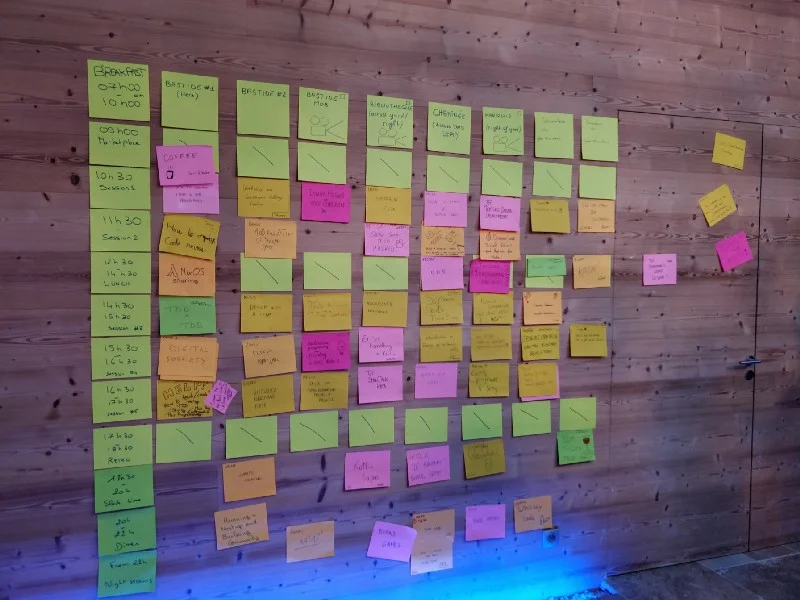
The agenda isn't known in advance. Instead, it takes shape each morning from the many workshop proposals that everyone is encouraged to submit. The October 18 agenda — so hard to choose with this many options!
Software quality is part of AXA's DNA, so it was natural for us to sponsor the event and send our developers. I was lucky enough to attend and discuss a wide range of topics — from DDD to code reviews, green IT, and many katas.
Here are some highlights from the discussions I had over those four days.
Code Reviews
I didn't expect code reviews to spark such intense discussions. To me, it's something everyone does as part of best practices when striving to improve software quality.
But no! Even code reviews have their detractors.
Their main argument is that reviews are usually done poorly. For example, reviewers don't pull the code locally — they just skim through it during a pull request or when someone presents code to them. In the end, reviews only catch naming issues, typos, formatting problems, or obvious bugs.
Meanwhile, reviewers rarely question the business logic being implemented, partly because the whole team doesn't know every feature in detail. Worse, the level of scrutiny varies based on trust in the author! We tend to trust someone who's been on the team longer and makes fewer mistakes.
Given this reality, some companies have stopped doing code reviews altogether, opting instead for much more pair programming and mob programming.
Pair Programming
Pair programming is a working method where two developers work together at the same workstation.
This technique proves useful for newcomers (whether experienced or junior) to learn the team's working methods and established best practices. It also avoids the potential back-and-forth of early pull requests.
Those back-and-forths are counterproductive: the same code gets reviewed multiple times, development stalls, and the developer may feel frustrated or take comments personally. Once this pair programming phase ends — which can be seen as mentoring and typically lasts several weeks — you can trust these people and stop reviewing their code entirely (or at least not every line).
Mob Programming
Mob programming is similar to pair programming, except the entire team works on the same feature! One key advantage is that the whole team shares both business knowledge and code ownership. You'll never hear "That's not my code/bug, it's Paul's" or "Who worked on this feature?" anymore. Since the code is written collaboratively, it's higher quality and doesn't need review afterward.
 Doing mob programming is like pair programming to the power of n — meaning
you get sustainable code. — Someone during a discussion at SoCraTes
Doing mob programming is like pair programming to the power of n — meaning
you get sustainable code. — Someone during a discussion at SoCraTes
Katas
During this event, I practiced several katas that helped me discover a new language (Haskell) and new ways of coding. A code kata is a development exercise that helps you hone your skills through practice and repetition.
If you're interested, here are the katas I practiced:
TCR Instead of TDD
I had the chance to try TCR, an acronym for test && commit || revert. It's a programming method proposed by Kent Beck (the inventor of TDD). The principle: when you run tests, if they fail, you revert your code!
We applied a slightly less extreme version during the kata. Before running tests, we'd bet on whether they'd pass or not. If we won the bet, we'd commit; otherwise, we'd revert. This approach still lets you go through the "red bar" phase where you see failing tests.
I preferred this approach. You spend less time "running tests in your head" to avoid seeing all your code (including the latest test) disappear. Most importantly, you keep the benefit of seeing your tests fail before they pass — which I consider a crucial part of the TDD I practice daily.
However, TCR does force you to go through the obvious implementation phase of the test (bet it'll be green, commit) before refactoring (if it doesn't work, revert and return to a working state).
Fish Bowl Mob Programming
Before SoCraTes, I'd heard of mob programming but had never tried it. During one kata, we experimented with a specific facilitation technique for mob programming: the fish bowl.
The rules are fairly simple:
- A driver has the keyboard. They only code and don't make decisions.
- A navigator tells the driver what to do. They're the only one speaking.
- One chair is open for questions. But beware — only questions to better understand the code (e.g., an unfamiliar syntax) or the business logic. You can't ask questions like "Why are we doing it this way?" — in that case, you take the navigator's seat!
- Everyone else stays silent and can take the driver's or navigator's place at any moment.
I really liked this technique for mob programming because it prevents the chaos that can arise when everyone tries to code at once. In those situations, the driver doesn't know what to do, and it's hard to make progress.
Since the event, I've tested this technique during a kata and the format was well received. However, like other techniques, I think you need to practice it first before using it daily on production code.